
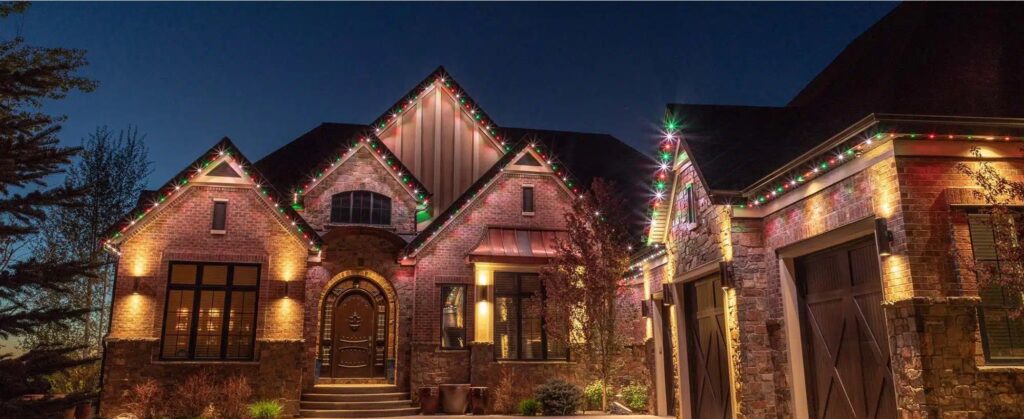
Understanding trim lighting vs landscape lighting is essential for making informed decisions. In fact, outdoor lighting does more than make your home look good at night. However, it provides security, extends your usable outdoor hours, and increases property value. For example, for Arizona homeowners, the two most popular options in 2026 are permanent LED trim lighting (sometimes called permanent holiday lighting) and traditional low-voltage landscape lighting.
This guide compares both options head-to-head — plus string lights and solar alternatives — so you can choose the right system for your home, budget, and HOA.
trim lighting Arizona: What Is Trim Lighting?
Additionally, trim lighting is a permanent LED lighting system mounted along the roofline, fascia, eaves, or soffits of your home. In fact, each fixture contains individually addressable RGB or RGBW LEDs that can produce millions of colors and are controlled through a smartphone app.
Unlike traditional Christmas lights that go up in November and come down in January, trim lighting stays installed year-round and serves as accent lighting, security lighting, and holiday lighting all in one system.
trim lighting Arizona: How Trim Lighting Works
- LED modules are mounted in an aluminum channel (track) that attaches to the roofline or fascia. The track is color-matched to your home’s exterior, making it nearly invisible during the day.
- A controller box (typically installed in the garage or attic) powers the system and connects to your home Wi-Fi.
- An app lets you select colors, set patterns, schedule automations, and choose from pre-built holiday themes (Christmas, Halloween, Fourth of July, game day colors, etc.).
- Smart home integration is available with most systems, allowing trim lights to be included in automation scenes through Control4, Savant, or other platforms.
Popular Trim Lighting Brands
- Gemstone Lights: Commercial-grade, individually addressable, premium build quality. Typically dealer-installed.
- Jellyfish Lighting: Individually addressable, good app, wide dealer network. Mid-to-premium pricing.
- Permanent Lighting Systems (PLS): Professional-grade, strong track design, good color rendering.
- EverLights: More affordable entry point, DIY-friendly option available alongside professional installation.
- Trimlight: Large dealer network, multiple track profile options, solid app experience.
Comparison Table: Trim Lighting vs Landscape Lighting vs String Lights vs Solar
| Factor | Trim Lighting | Landscape Lighting | String Lights | Solar Lights |
|---|---|---|---|---|
| Upfront Cost | $2,000 – $6,000+ | $3,000 – $15,000+ | $200 – $1,500 | $100 – $800 |
| Monthly Energy Cost | $5 – $15 | $10 – $30 | $5 – $15 | $0 |
| Lifespan | 15-25 years (LEDs) | 15-20 years (fixtures), bulbs vary | 2-5 years | 1-3 years (batteries degrade) |
| Maintenance | Very low | Moderate (bulb replacement, repositioning, plant growth) | Moderate (replacement, re-hanging) | High (battery replacement, repositioning) |
| Holiday Lighting | Yes — unlimited colors and patterns | No | Limited (single color or warm white) | No |
| Security Lighting | Yes — bright white mode | Yes — excellent path and perimeter lighting | Minimal | Minimal and unreliable |
| Accent Lighting | Roofline and architectural | Gardens, paths, trees, walls | Patios and pergolas | Paths and garden borders |
| Color Options | 16 million+ (RGB/RGBW) | Warm white, occasionally color filters | Warm white, some multi-color | Warm white, some color-changing |
| Smart Home Integration | Yes (app + Control4/Savant) | Yes (with smart transformers) | Limited | No |
| Curb Appeal | High (dramatic, modern) | High (elegant, classic) | Moderate (casual, festive) | Low to moderate |
| Arizona Heat Durability | Excellent (rated for 140F+) | Excellent (brass/copper fixtures) | Fair (plastic degrades in UV) | Poor (batteries fail in extreme heat) |
| HOA Friendly | Generally yes (invisible by day) | Yes | Varies (often restricted) | Yes |
| Installation | Professional recommended | Professional recommended | DIY | DIY |
Trim Lighting: Detailed Pros and Cons
Pros
- Year-round versatility. One system replaces holiday lights, accent lighting, and security lighting. You never climb a ladder to hang Christmas lights again.
- Invisible by day. The aluminum track and LED modules are designed to blend with your roofline. From the street, most people cannot see the system during daylight hours.
- Low maintenance. LEDs last 50,000+ hours. There are no bulbs to replace, no timers to adjust seasonally, and no physical setup or teardown.
- Desert-proof. Quality trim lighting systems handle temperatures exceeding 140 degrees Fahrenheit, which matters when your roofline hits 160 degrees on a July afternoon in Phoenix. The aluminum track does not warp, crack, or fade like plastic alternatives.
- Energy efficient. A typical whole-home trim lighting system draws 100 to 300 watts, costing $5 to $15 per month to run nightly.
- Instant holiday decorating. Switch from warm white accent lighting to a red-and-green Christmas pattern, orange-and-purple Halloween theme, or red-white-and-blue Fourth of July display in seconds through the app.
- Home value. Permanent trim lighting is increasingly seen as a desirable feature in Arizona real estate listings, similar to a pool or outdoor kitchen.
Cons
- Roofline-only coverage. Trim lighting illuminates the roofline and architectural edges of your home. It does not light garden beds, walkways, or trees. For full outdoor lighting, you may still need landscape lighting in addition to trim lighting.
- Upfront cost. Professional installation ranges from $2,000 for a small single-story home to $6,000 or more for a large two-story with complex rooflines. This is higher than a basic string light setup but lower than comprehensive landscape lighting.
- Professional installation required (for best results). While some brands offer DIY kits, proper installation on Arizona rooflines — especially tile roofs — requires experience to avoid leaks, ensure clean sightlines, and route wiring safely.
- App dependency. You need the manufacturer’s app (and sometimes a subscription) to control colors and scenes. If the company goes out of business or discontinues the app, functionality could be affected. Choosing a system that integrates with a local smart home controller mitigates this risk.
Landscape Lighting: Detailed Pros and Cons
Pros
- Comprehensive coverage. Landscape lighting illuminates pathways, garden beds, trees (uplighting and downlighting), architectural walls, water features, and entryways. It creates depth and drama across your entire property.
- Proven technology. Low-voltage landscape lighting has been the standard for decades. Fixture designs, transformer technology, and installation techniques are mature and reliable.
- Security. Well-placed landscape lighting eliminates dark zones around your home’s perimeter, deterring intruders and illuminating camera coverage areas.
- Property value. Professional landscape lighting consistently ranks among the top exterior upgrades for home value, with studies showing a 15% to 20% increase in perceived property value.
- Design flexibility. A lighting designer can create custom looks — moonlighting from trees, grazing on stone walls, silhouetting saguaros, illuminating pool water features — that trim lighting cannot replicate.
Cons
- Higher total cost for full coverage. A comprehensive landscape lighting system for a typical Arizona home costs $3,000 to $15,000+ depending on the number of fixtures, transformer capacity, and design complexity.
- Maintenance. LED landscape fixtures are more reliable than halogen predecessors, but you still need to account for occasional fixture repositioning (as plants grow), wire repairs (landscape crews sometimes cut buried wire), and transformer maintenance.
- No holiday lighting capability. Landscape lighting produces warm white light (occasionally with color filters). It cannot display holiday colors, patterns, or animations.
- Professional design matters. Poorly designed landscape lighting creates glare, hot spots, and uneven coverage. This is one area where hiring an experienced lighting designer pays for itself.
Arizona HOA Considerations
Furthermore, hOA rules vary across the Phoenix metro area, but there are common patterns that affect your lighting choices.
Trim Lighting and HOAs
Most Arizona HOAs allow permanent trim lighting because:
- The track is nearly invisible during the day
- The system is architecturally integrated, not “hung” like traditional holiday lights
- When set to warm white, it looks like built-in architectural lighting
Potential issues: Some HOAs restrict display of animated or colored lighting to specific holiday windows (e.g., December 1 through January 15). In contrast, check your CC&Rs before assuming you can run a red-and-green light show year-round. Most homeowners run warm white or amber accent lighting most of the year and switch to holiday colors during approved periods.
Landscape Lighting and HOAs
Landscape lighting is universally permitted by Arizona HOAs, provided:
- Light does not spill excessively onto neighboring properties
- Fixtures are not overly bright or create glare visible from the street
- Installation does not damage common-area landscaping
String Lights and HOAs
For example, string lights are the most commonly restricted lighting type. Many Arizona HOAs:
- Prohibit string lights outside of designated holiday periods
- Restrict string lights to backyards only (not visible from the street)
- Require removal within 30 days after a holiday
If your HOA restricts string lights, permanent trim lighting is the compliant alternative that gives you similar (and better) functionality.
Cost Breakdown by Lighting Type
Trim Lighting Costs
| Home Size | Linear Feet | Estimated Cost |
|---|---|---|
| Small single-story (1,200-1,800 sq ft) | 80 – 120 ft | $2,000 – $3,000 |
| Medium single-story (1,800-2,800 sq ft) | 120 – 180 ft | $3,000 – $4,500 |
| Large single-story or small two-story | 180 – 250 ft | $4,500 – $6,000 |
| Large two-story or complex roofline | 250 – 400+ ft | $6,000 – $10,000+ |
As a result, costs include materials, professional installation, controller, and app setup. In fact, tile roof homes may incur a $300 to $800 premium for specialized mounting hardware.
Landscape Lighting Costs
| Scope | Number of Fixtures | Estimated Cost |
|---|---|---|
| Front yard accent lighting | 6 – 10 fixtures | $1,500 – $3,000 |
| Front and back yard | 12 – 20 fixtures | $3,000 – $6,000 |
| Full property with trees and features | 20 – 40 fixtures | $6,000 – $12,000 |
| Estate or large lot | 40 – 80+ fixtures | $12,000 – $25,000+ |
Costs include fixtures, transformer, wiring, and professional installation. Moreover, high-end brass and copper fixtures (Unique Lighting, FX Luminaire, Coastal Source) cost more than cast aluminum but last significantly longer in Arizona’s UV-intense environment.
The Combined Approach
Many Arizona homeowners install both trim lighting and landscape lighting for complete coverage. A common pairing:
- Trim lighting for roofline accent, holiday displays, and architectural drama ($3,000-$5,000)
- Landscape lighting for pathways, gardens, trees, and security perimeter ($3,000-$8,000)
- Combined total: $6,000 to $13,000 for a well-lit property with holiday capability
In particular, this combination delivers the best overall result and is what we most frequently install at Trident Integration.
Maintenance and Durability in Arizona’s Desert Climate
What Arizona’s Climate Does to Outdoor Lighting
- UV radiation degrades plastic fixtures, yellowing lenses and cracking housings within 2 to 4 years. Metal and glass fixtures hold up significantly better.
- Extreme heat (roofline temperatures exceeding 160 degrees Fahrenheit) stresses electronics, adhesives, and wiring insulation. Cheap LED drivers fail prematurely in these conditions.
- Monsoon storms bring high winds, blowing dust, and heavy rain. Fixtures need to be IP65-rated or higher to withstand water intrusion. Wire connections must be waterproof (gel-filled connectors, not wire nuts).
- Hard water from irrigation sprinklers deposits mineral scale on fixture lenses, reducing light output over time. Brass and copper fixtures develop a natural patina that many homeowners find attractive.
Maintenance Schedule by Lighting Type
| Lighting Type | Annual Maintenance | Notes |
|---|---|---|
| Trim lighting | Inspect track mounting annually, clean lenses every 2-3 years | Virtually maintenance-free in practice |
| Landscape lighting | Inspect fixtures, check wiring, reposition as needed, clean lenses | Budget 2-4 hours of service annually |
| String lights | Replace strands every 2-4 years, re-hang as needed | Higher ongoing cost due to replacement |
| Solar lights | Replace batteries annually, replace units every 1-3 years | Most cost-ineffective option long-term |
Which Option Should You Choose?
Choose trim lighting if: You want holiday lighting capability, love the look of an illuminated roofline, and want extremely low maintenance. In fact, ideal as a standalone system for homes where roofline drama is the priority.
On the other hand, Choose landscape lighting if: You want comprehensive ground-level coverage, security lighting around the perimeter, and a classic upscale look. In fact, essential for homes with mature landscaping, saguaros, or water features worth highlighting.
Choose both if: You want the complete package — architectural drama on the roofline, garden and pathway illumination at ground level, and holiday lighting capability without seasonal ladder work.
Therefore, Skip string lights if: Your HOA restricts them, you are tired of replacing them, or you want something that looks professional year-round.
Skip solar if: You live anywhere in the Phoenix metro area and want reliable lighting. In fact, battery degradation in Arizona heat makes solar path lights a false economy.
Get a Lighting Consultation for Your Arizona Home
Specifically, trident Integration designs and installs both trim lighting and landscape lighting systems across the Phoenix metro area. In fact, we will evaluate your home’s architecture, roofline, landscaping, and HOA requirements to recommend the right system — or combination of systems — for your property.
We are experienced with all major trim lighting brands and design custom landscape lighting layouts tailored to Arizona homes. Consequently, every installation includes our workmanship warranty and our 20+ years of experience in the Arizona market.
Call Trident Integration at (480) 658-0504 or request a free consultation online to get a custom lighting plan for your home.
For expert trim lighting vs landscape lighting services, trust the professionals at Trident Integration with over 20 years of experience.
Meanwhile, trim lighting in Arizona is especially popular because the permanent LEDs withstand 115°F+ desert heat without fading or warping.
For Arizona homeowners, trim lighting offers the best combination of year-round aesthetics and holiday versatility.
Trim lighting Arizona installations withstand withstand 115°F+ summers, monsoon dust, and intense UV exposure year-round.
In addition, homeowners choosing trim lighting Arizona enjoy permanent holiday-ready illumination without the annual hassle of hanging temporary lights.
The popularity of trim lighting Arizona has surged in HOA communities where temporary holiday decorations face strict restrictions.
For trim lighting Arizona quotes and a free consultation, contact Trident Integration at (480) 658-0504.
When comparing options, trim lighting Arizona stands out for its low maintenance, app-based control, and 50,000+ hour LED lifespan.